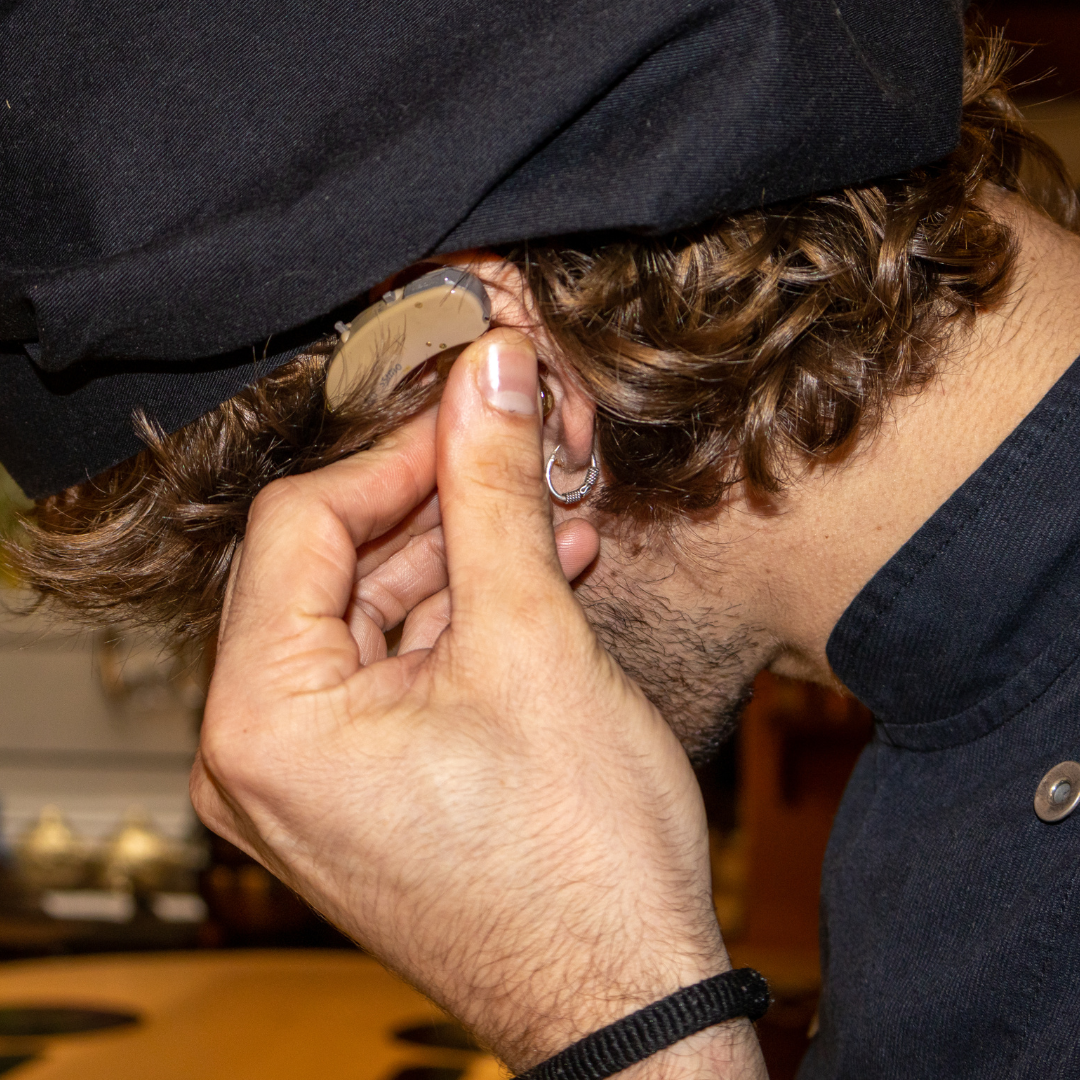
Following dinner conversations becomes challenging when high ambient noise interferes with your focus and hearing. Our clinical team can evaluate hearing across quiet settings and background-noise environments to pinpoint specific auditory challenges. After uncovering the precise factors driving your difficult hearing, our team helps you select individualized auditory solutions.
Why Everyday Hearing Fails in Busy, Noisy Restaurants
A quiet setting creates an optimal signal-to-noise ratio, ensuring the conversational partner’s voice rises cleanly above ambient sounds. Busy dining establishments generate the exact reverse scenario. Multiple voices, music, kitchen noise, and reverberation overlap with speech, forcing the ears and brain to work harder to separate the person you want to hear.
Such listening challenges typically stem from high-frequency hearing loss, auditory-processing deficits, or accumulated noise-induced trauma. Poor visual illumination, mental fatigue, physical distance from the speaker, and divided focus exacerbate speech-recognition problems. Certain patients demonstrate normal sensitivity on routine audiograms while struggling significantly during advanced speech-in-noise testing. Experiencing speech-recognition struggles in noisy dining venues warrants a formal audiological evaluation regardless of seemingly normal quiet hearing.
How Audiologists Identify High-Frequency Hearing Loss
We begin with a history of the situations that cause trouble, along with questions about noise exposure, tinnitus, medications, family history, and changes in either ear.
Standard pure-tone audiometry gauges the lowest volume thresholds detectable across varying acoustic frequencies via specialized earphones and bone oscillators. Patients with high-frequency hearing loss typically exhibit a sloping audiogram configuration where sensitivity steadily declines at elevated pitches. Extended test batteries incorporate acoustic tympanometry to rule out middle-ear pathology along with suprathreshold word-recognition testing.
Because testing in a silent booth does not mirror real-life restaurant environments, speech-in-noise testing supplies vital diagnostic clarity. This procedure gauges speech-discrimination accuracy while competing multi-source noise becomes incrementally louder. Interpreted together, these clinical scores demonstrate whether listening struggles originate from loss of audibility, speech clarity deficits, auditory processing delays, or combined elements.
Understanding Auditory Processing Disorders in Noisy Environments
An auditory processing disorder degrades the central nervous system’s capacity to organize and interpret complex sound inputs. While peripheral ears may register soft tones normally, the auditory cortex struggles to filter competing noise, resolve phonetic contrasts, or keep pace with rapid conversation. We first evaluate peripheral hearing and then determine whether an individualized auditory-processing test battery or referrals to other professionals are appropriate.
Behavioral Strategies for Hearing Clearly in Loud Venues
Strategic behavioral modifications can substantially improve the auditory signal reaching your ears while maximizing supportive visual cues. Before leaving home, identify quieter dining venues or plan to eat during less crowded service times. Settings constructed with comfortable booths, acoustic ceiling panels, drapery, and carpeted walkways facilitate easier communication than open venues with concrete and glass.
When arriving at the dining venue:
- Select a secluded table situated away from prep kitchens, crowded bar stations, loudspeaker zones, and large parties.
- Situate yourself with a structural wall behind you to minimize distracting ambient noise from behind.
- Position yourself to directly face companions under bright lighting to enhance facial comprehension.
- Keep conversational proximity as close as comfortably feasible to preserve acoustic signal strength.
- Turn your better-hearing ear toward the specific speaker you want to hear most clearly.
- Request that companions rephrase misunderstandings using different words rather than repeating the same sentence.
- Clarify critical details explicitly instead of nodding along or pretending to catch the message.
- Take a brief listening break when fatigue begins to build.
- Request that friends speak with crisp clarity rather than speeding through dialogue.
- Elevated yelling distorts auditory signals and seldom improves actual phonetic comprehension.
Advanced Technology for Hearing in Background Noise
Determining the proper hearing technology hinges on the underlying disorder, everyday listening environments, and whether peripheral hearing loss is diagnosed. Prescription hearing aids fitted by an audiologist leverage directional microphone arrays, advanced digital noise reduction, and dedicated restaurant programs to focus on frontal speech while dampening background sound. They still require realistic expectations because no device can remove every unwanted voice.
Remote wireless microphones offer an exceptional boost to the signal-to-noise ratio in challenging venues. Clipped near the speaker’s mouth or set nearby, the transmitter sends voice signals wirelessly to matched hearing aids or a receiver. Direct audio routing minimizes the acoustic penalty of conversational distance and surrounding environmental din.
Other clinically valuable tools include:
- Multi-directional table microphones designed for small dinner gatherings
- Telecoil sensors configured to access hearing-loop broadcasts in looped facilities
- Mobile speech-to-text applications delivering instant visual captions during dinner
- Over-the-counter hearables equipped with directional speech-enhancement algorithms
- Decibel-monitoring apps and crowd-sourced dining platforms that track restaurant noise
We can compare options, confirm compatibility, and teach you how to use the selected device.
Professional Audiological Solutions for Loud Listening Environments
A comprehensive hearing evaluation looks far beyond the common misconception of “I hear fine in quiet environments.” We analyze the exact social venues, voice registers, and noise environments that cause difficulty to administer tests matching your lifestyle. The diagnostic battery may encompass pure-tone thresholds, acoustic middle-ear evaluations, suprathreshold word recognition, and speech-in-noise measures. Dedicated central auditory-processing testing will be scheduled if your history and primary diagnostic testing indicate central pathway issues.
Abrupt auditory reductions, unilateral hearing shifts, or rapid functional deterioration require prompt assessment by an ear, nose, and throat physician. Comprehensive clinical care targets the physiological roots of hearing difficulties rather than simply writing them off as bad restaurant acoustics.
Request an Audiology and Hearing Evaluation Today
When dining out causes you to guess at words, detach from family, or experience severe listening exhaustion, book a comprehensive hearing evaluation with us. Our clinical team will determine the best strategies to improve your hearing in noisy environments through custom hearing-aid programming, remote microphones, or targeted auditory rehabilitation.
Reach out to our audiology clinic today to schedule an evaluation and begin enjoying clear, effortless conversations.